 01.12.2025
 We are returning clean air to apartments in Tashkent
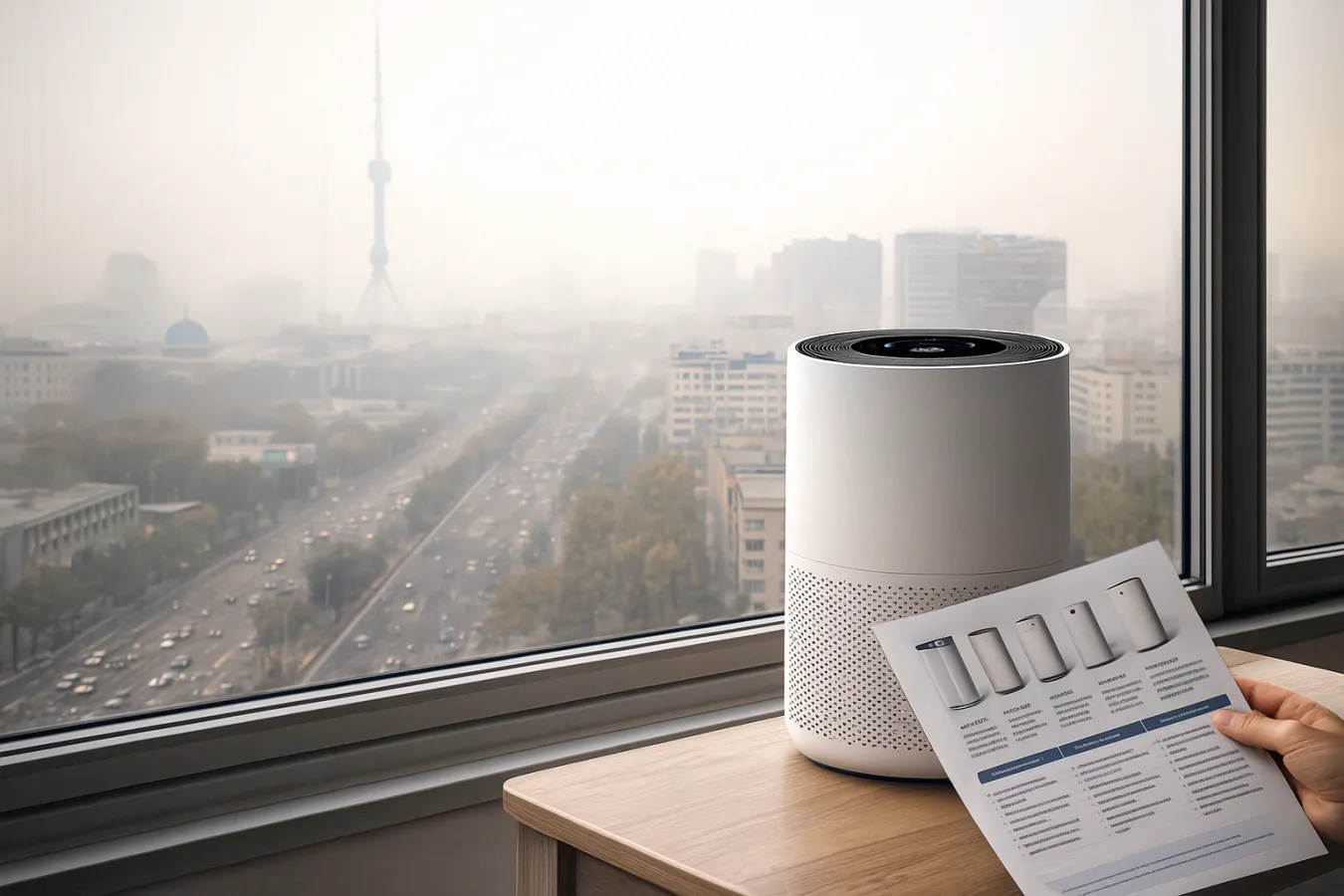
If a couple of years ago talking about air purifiers seemed like something for the "particularly anxious", now in Tashkent it's not about anxiety, but about lung survival. In winter, the city consistently climbs into the world rankings of the dirtiest in the air: the concentration of fine PM2.5 particles is several times higher than WHO recommendations, and on some days more than ten times.
People react predictably: closed windows, masks, a surge in demand for cleaners. The market is also predictable: prices are creeping up, sellers are starting to pass off humidifiers as "super-cleaning stations," and any box with a fan and filter as a "professional HEPA complex." Against this background, the president signs a decree: household air purifiers are exempt from customs duties precisely as a measure to remedy the environmental situation in Tashkent.
Q: Do I need a cleaner?"It almost doesn't sound anymore. It sounds different: What exactly should I buy so that it's not an expensive white dummy box?
Golden Pages is sorted out in order.
What are we cleaning anyway?
It is important to understand what you are trying to protect your apartment or office from. In a city where the air turns into a thick soup of exhaust fumes, coal smoke and construction dust in winter, the main enemy is small particles of PM2.5. These are tiny pieces of soot and dust up to 2.5 micrometers in size that fly past the natural filters in the nose and settle in the lungs and blood vessels. According to the World Bank (yes, it is he), the average annual concentration of these particles in Tashkent is six times higher than the WHO norm.
Plus to this:
- dust (construction, outdoor, ordinary household);
- allergens (pollen, animal hair, mites);
- odors and gases (No₂, so₂, volatile organic compounds - everything that transport and heating are rich in);
- microbes and mold spores.
There is no one universal device that will perfectly solve everything at once. Therefore, the first step is to answer yourself honestly.: What is most important to you?
- do you live near a big road? we rely on the fight against fine dust;
- allergy/asthma needs a strong particle filter and a good pre-filter;
- lots of smells, tobacco, kitchen - we add a carbon filter to this;
- stuffiness in the apartment - we are already looking not only at cleaners, but also at supply ventilation and heat recovery.
Cleaning and ventilation: two different tasks
It is a common mistake to expect that one device "will purify the air and bring fresh air." It doesn't work that way.
- An air purifier drives the same air in a circle through a filter. It removes dust, particles, some allergens, and sometimes odors, but it doesn't add oxygen to the room.
- Ventilation and recuperation are the opposite: they throw out old air and draw in fresh air from the street. There are filters in a normal system, but their goal is not to bring it to sterile cleanliness, but not to let coarse dust and dirt into the house.
With a good heat exchanger, you do not lose heat in winter (the heat exchanger gives part of the energy of the outgoing air to the supply air) and still breathe outdoor air, just a little cleaner and warmer.
The ideal combination for Tashkent is supply ventilation/recuperation + a normal cleaner in key rooms (bedroom, children's room, study). But if your budget is limited or you rent a house and can't fit into the walls, we start with a portable cleaner and only then we think about stationary systems.
Types of equipment: what kind of box do you have at home
1. Household Air Purifier
A classic "white tower" or a box with a fan and filters. The real effectiveness depends almost not on the appearance, but on what is inside.
The main elements:
- The pre-filter. It catches coarse dust, wool, and hair. It is often a mesh that can be washed. If it is not present, the main filter will get clogged and you will have to change it too often.
- HEPA filter. The heart of the system. This is a dense fiber filter that traps fine particles, including the very PM2.5. Real HEPA filters are divided into classes (H11, H13, and so on) and are capable of detaining up to 99.97% of particles of a certain size.
- Carbon filter. It absorbs odors and some gases, including volatile organic compounds. A good charcoal block is heavy: it has a lot of activated carbon in it, not one thin "mat" for show.
Sometimes they add:
- UV lamp for disinfection;
- ionization and other plasmas
- photocatalysis, ozone and other scary words.
These "dopers" should be treated calmly and a little suspiciously. With proper construction, they can help, but HEPA + coal always does the main work. And some ozonators, when abused, create a side problem: ozone in high concentrations is also harmful to the lungs.
2. Recuperators and air conditioning units (breezers)
This is no longer a portable box, but part of the apartment/office engineering. Supply air unit with recuperation:
- takes air from the street;
- drives it through the filter (at least from coarse dust, and in good models also from small particles);
- "takes away" the heat from the exhaust air in order not to throw money for heating outside;
- supplies the already prepared air to the premises.
In winter in Tashkent, when it's scary to open the window, but you still need to breathe, heat recovery is almost the only civilized way to get both air and relative humidity.
3. Noise
A cleaner that cleans well, but at the same time buzzes like an airplane, will not live in the bedroom: it will simply be turned off.
We are looking at the noise level in decibels:
- up to 20-25 dB (conditional) night mode
- 30–35 dB— tolerable background for living room/study;
- above 40 dB is already a noticeable noise.
It is important to understand that maximum performance almost always = maximum noise. So the honest scenario is to keep the appliance on medium mode all the time, and to blow the apartment a couple of times a day at maximum.
4. Cost of filters and maintenance
Another trap is to buy an inexpensive cleaner, and then every six months leave the cost of the device itself at the checkout in the form of new filters.
Please specify before purchase:
- how much do replacement cassettes cost;
- how often do they really need to be changed in the Tashkent air (and not in ideal laboratory conditions);
- are there any original filters on sale or just an analog from the neighboring basement on Malik.
If the filters are difficult to find, and the supplier cannot clearly answer about the terms and prices, you may be left with a beautiful but completely useless box in a year.
5. Sensors and smart functions
Useful chips:
- PM2.5 sensor (not just the general dust sensor);
- automatic mode - the device itself revs up if the air deteriorates;
- filter resource indicator;
- is a normal mobile application if you like to control everything from your smartphone.
You can live without it, but in conditions of constantly jumping air quality in Tashkent, the automatic mode is not a whim, but just a convenience: the device itself reacts to what is happening outside the window.
What to choose for a specific task
Apartment in Tashkent, family, children
Basic set:
- decent cleaner with HEPA H13 and carbon filter in the bedroom and nursery;
- the second one, if possible, in the living room/kitchen;
- when repairing or moving, consider the supply/recovery in at least one room where everyone is sleeping.
Pay special attention to noise: children will not sleep under the hum. And the filter resource: in reality, in Tashkent, they are more often changed every 6 to 9 months, rather than every two years, as they like to write in advertising.
Office or coworking space
The more important thing here is not the "quiet night mode", but the ability to process a large volume of air.
- We are looking at the total CADR for the room: it should cover 3-4 volumes per hour.
- We install several medium-power devices by area, rather than one giant one in the corner.
- Do not forget about the supply ventilation: sitting all day in a tightly closed room, even if perfectly cleaned, is also not the best idea (it works better with fresh air)
Allergy sufferers and asthmatics
The main goal here is to minimize the concentration of allergens in the bedroom and in the places where a person spends the most time.
- HEPA is a good class of masthead filter
- it is desirable that the device can operate around the clock in a quiet mode;
- if there are animals at home, make sure that the filters are not clogged with wool.
About recuperators again, but without fanaticism
There is a temptation to solve everything at once and install a "powerful heat exchanger" that will give fresh air and remove dust. It is technologically possible, but there are nuances.:
- filters in recuperation plants are rarely of the same class as in household cleaners, otherwise the resistance will be too high;
- the system is designed for a constant moderate influx, and not for "turbo cleaning" with the next release of smog;
- installation and maintenance cost a lot of money.
That is, a recuperator is a great investment in a long life in this apartment/house. But if you are renting a house or are not ready for repairs, it is easier to start with portable cleaners, and return to engineering when you make major repairs.
Why have prices jumped so much and what do duties have to do with it
The logic is simple: the air deteriorated sharply, people rushed massively for purifiers, and the market was not ready for this. Stocks in warehouses quickly dispersed, new shipments are delayed and at different prices. At the same time, unscrupulous sellers have become more active:
- Chinese humidifiers are being redesigned under the guise of "ion cleaners"
- they slip devices without a normal filter, but with a beautiful display;
- they sell pseudo-HEPA without certificates.
Until recently, the customs burden was also added to this: a duty of 20% of the cost was applied to household cleaners, but not less than $ 3 per piece.In conditions of high demand, this easily turned into an additional mark-up in the store.
After another "winter of smog," the issue could no longer be ignored, and the president signed a decree that exempts household air purifiers from customs duties. This is described in the document as one of the urgent measures to improve the environmental situation in Tashkent.
Formally, this should remove some of the price pressure and make normal devices more affordable. In practice, stores are not always in a hurry to share their savings with the customer right away, so it makes sense:
- compare prices from different sellers;
- look at official importers, not just grey imports
- do not be led to overt dumping where the device is suspiciously cheap.
How not to become a victim of marketing
Briefly about the typical tricks that are already walking around Tashkent shops, on the well-known "Malika" and marketplaces:
- «German technology» without specifying the brand and model. If there is no normal passport in Russian/English/Uzbek, most likely, you have a new name in front of you.
- "An ionizer that cleans everything without a filter" sounds nice, but you can't fool physics: the particles need to be collected somewhere. Without a filter, they will either settle inside the appliance (which no one cleans) or remain in the room.
- A humidifier with the signature "purifies the air". Humidification can indeed reduce the amount of dust in the air, but it is not a substitute for filtration. Plus, if used improperly, you can get mold and water blooming.
- Overly optimistic promises like "clears 60 meters in 10 minutes on minimum mode." We are looking at CADRS, not slogans.
The result
In Uzbekistan, the air purifier has ceased to be a gadget for perfectionists and has turned into a normal household appliance, like a refrigerator or washing machine.
The task is not to buy the most expensive box with the maximum number of light bulbs, but to choose your own working configuration.:
- understand what you are protecting yourself from - smog, allergies, odors, or all at once;
- select by numbers: area, CADR, filters, noise, maintenance cost;
- if possible, add to this an influx of fresh air through a heat exchanger, supply ventilation or modern split systems with a real influx, and not just a beautiful icon.
And already rising prices and a market for unscrupulous sellers are, unfortunately, a side effect of any massive problem. We all need now: a little more critical thinking, less faith in miracle devices, and then the air purifier in the house or office will become not a toy, but a quiet but very useful assistant.
Be healthy!
 470
470
 14.08.2025
Recent articles: